  |
|
[
Home ] [ Suspension types ] [ Tutorials ] [ Downloads ] [ Data files ] [ FAQ
] [ Purchase here ] [Contact us
] [ SusProg3D Evaluation CD]
|
|
|
[
Home ] [ Suspension types ] [ Tutorials ] [ Downloads ] [ Data files ] [ FAQ
] [ Purchase here ] [Contact us
] [ SusProg3D Evaluation CD]
|
When
used as a front suspension there are four chassis mounting points, one
for the strut rod top mounting, one for each lower link and one for the
steering tie rod (which can be either the end of the steering rack, or
the tie rod mounting on the track rod).
When used as a rear suspension there are either three or four mounting points, one for the strut rod top mounting, one for each lower link, and either a separate toe link mounting, or the toe link mounting can be common with one of the lower link mountings. Four strut mounting points, one for the strut rod top mounting, one for each lower link and either a steering arm or a toe control link mounting. 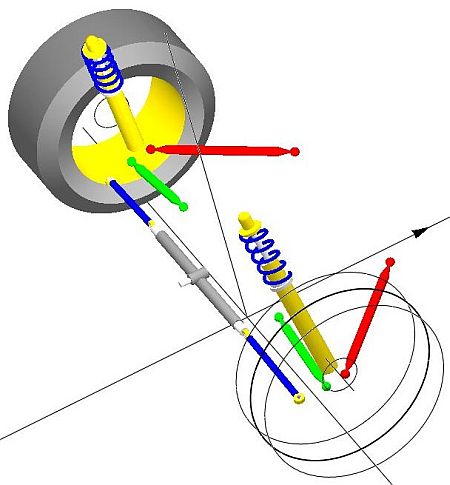 In
this configuration, commonly used on some BMW models, the bottom of the
strut is located by two links, each with their own ball joint pivot, with
the links angled (in plan view) to meet at a "virtual pivot" point. This
makes it easier to package the components such that the steering axis (which
passes through the virtual pivot point) can be moved further outboard than
would otherwise be possible.
The two links are usually arranged as a lateral link (which controls camber) and a diagonal link (which controls caster). Where these two links meet (in plan view) is the "virtual pivot point". The king-pin inclination and caster are measured from the strut rod mounting point on the chassis and the "virtual pivot point". |
Return to SusProg3D suspension types page
|
JOIN
the SusProg3D
Mailing List and be kept informed on the latest developments
We DO NOT
sell, hire or loan names and address to other organizations My
Privacy Policy
 © 2012 Beven D Young All rights reserved


This page was last modified: